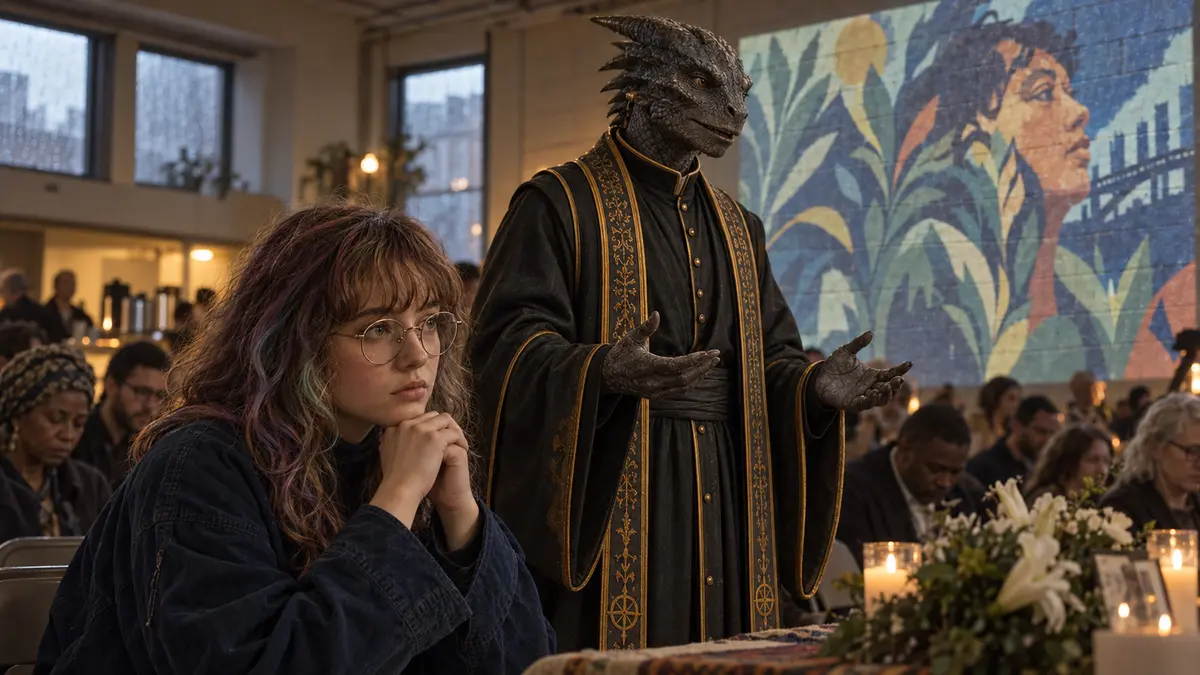
Hubert Herowin made art that belonged to the places he lived. His murals did not ask anyone to visit a gallery or learn the right vocabulary first. They met people where they were: on walls, along familiar routes, and inside the shared landscape of the neighborhood.
That choice mattered. A mural becomes part of daily life. People pass it on the way to school, work, worship, or home. They notice it in pieces before they ever stand back and see the whole. Hubert worked in that public grammar, making images that could live beside the people who inspired them.
At his service, friends and family remembered a young Vardunian elf whose work had become part of their community’s visual memory. Some knew Hubert through the paintings. Others knew him from school or the Reclaimer Congregation House. The mural beside them held a record no institutional form could capture: his attention, his labor, and the places he chose to leave color behind.
His death is the subject of an active investigation, and his artwork may matter to that inquiry. But treating every surviving image only as potential evidence would repeat the same narrowing that turns an artist into a case number.
The work of remembering him is also the work of caring for what remains: naming the paintings, preserving the walls that carry them, and listening to the people who encountered Hubert through the art he made for their shared world.
← More from The Numenal